What happened
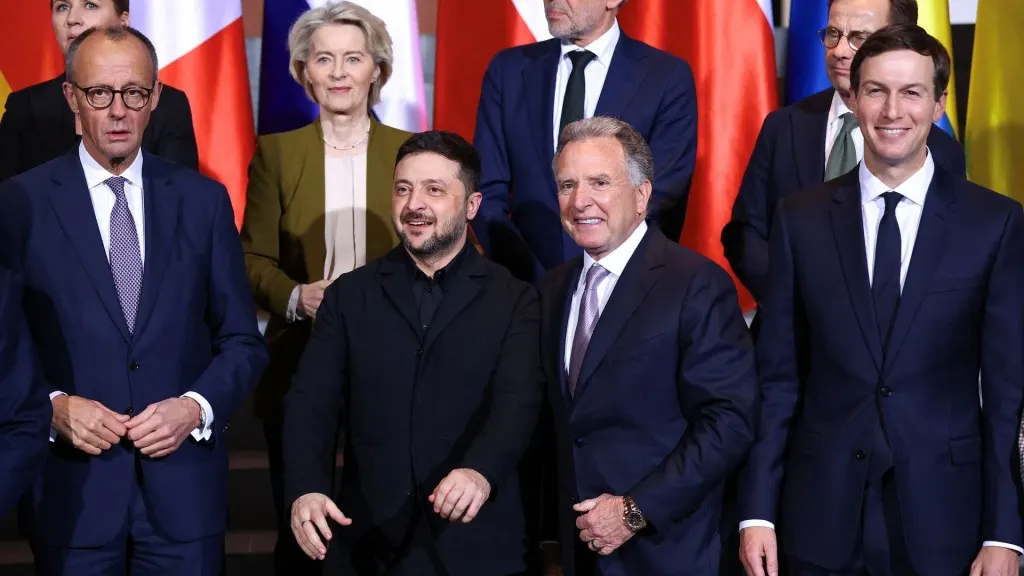
US President Donald Trump's envoy Jared Kushner told European leaders in Berlin on Thursday that he believes Russia is "comfortable" with NATO-like security guarantees for Ukraine once the war ends. The meeting brought together the "coalition of the willing," a nearly 40-nation group of Ukraine's European allies.
"We do believe that Russia having Europe at the table will be essential for ending the war," Kushner said. He added that Trump wants "to make a deal with Europe by his side." Fellow US envoy Steve Witkoff joined him at the talks, and Trump called in after his summit with Russian President Vladimir Putin and Chinese President Xi Jinping in Shenzhen.
Kushner said the guarantees would be modelled on NATO's Article 5, the alliance's collective defence rule that treats an attack on one member as an attack on all. "I think we've gotten the Russians comfortable with that concept where any security guarantee for Ukraine would be based on Article 5," he said. He added that Trump was "open" to the idea but that "obviously, it has to be in America's interest" and part of "a broader security package."
The claim landed hours after Putin, at the [Shenzhen summit](/article/trump-putin-xi-summit-explained), reiterated that Ukraine joining NATO or receiving the alliance's security guarantees would be "unacceptable" to Moscow. Within hours of Kushner's remarks, Russian Deputy Foreign Minister Sergei Ryabkov pushed back, saying any form of "quasi membership" for Kyiv in the Western military alliance was totally unacceptable.
Why it matters
Security guarantees are the central question of any Ukraine peace deal. Kyiv has sought NATO membership since it applied in September 2022, seven months after Russia's full-scale invasion began. The Kremlin has repeatedly said membership would trigger "a harsh response" and has cited Ukraine's NATO ambitions as one reason it launched the war.
The gap between the two sides was on full display in Berlin. French President Emmanuel Macron said Ukraine's NATO membership should be considered again, "faced with the maximalist nature of the Russian position." Ukrainian President Volodymyr Zelenskyy, meanwhile, said there was no common understanding at the meeting of what Article 5-style guarantees would actually mean. He asked whether they would mean US and European troops stationed on Ukrainian soil. "For me, the most important thing is how countries will react on aggression," he said.
Analysts are sceptical. Harry Nedelcu of the Rasmussen Global consultancy, who previously worked on the NATO secretary-general's policy planning staff, said Washington's approach looks inconsistent: one week it floats NATO membership for Ukraine in exchange for giving up the Donbas region, the next it offers NATO-like guarantees. "Russia has to agree to this proposal," he said, adding that so far Washington appears to be pressuring Ukraine to negotiate, not Russia.
What it means for the US
This is now a test of how far the US is willing to go as Ukraine's guarantor. Kushner framed the idea as conditional: it must be in America's interest. But an Article 5-style pledge would, in effect, commit the United States to treat a future attack on Ukraine as an attack on itself, the same commitment NATO members make to each other.
That is a hard sell at home. Eric Ciaramella of the Carnegie Endowment for International Peace wrote in a November 10 report for the Royal United Services Institute that the idea "strains credulity," noting the Trump administration has cut American support for Ukraine and wants to reduce the US role in European security. A more realistic course, he argued, would be legally binding agreements to supply weapons, training, defence industry cooperation and intelligence sharing for at least a decade after the war ends.
Ian Lesser of the German Marshall Fund put it more bluntly: "Much depends on US participation, and the American commitment to European defence is unfortunately in flux." Article 5 is not automatic, he noted, it requires a political decision by member states. For American readers, the question is concrete: would Washington send troops, weapons or money to defend Ukraine years from now, and under what terms?
What happens next
Nothing is agreed yet. The US has not spelled out what its proposed guarantees would look like, and Zelenskyy said the Berlin meeting produced no shared definition. The last round of [peace talks in Abu Dhabi](/article/russia-ukraine-peace-talks-explained) produced no major breakthrough, and the war continues. Russia hit Kyiv with a major missile attack on Friday morning, the same day Kushner spoke in Berlin.
The next steps will be whether Washington puts a written proposal on the table, whether Moscow engages with it, and whether [Europe's leaders, who said this week they are ready for talks with Russia](/article/europe-ready-for-russia-talks-ukraine-berlin), accept a deal shaped largely by the US. For now, the two sides are not even describing the same idea.