What happened
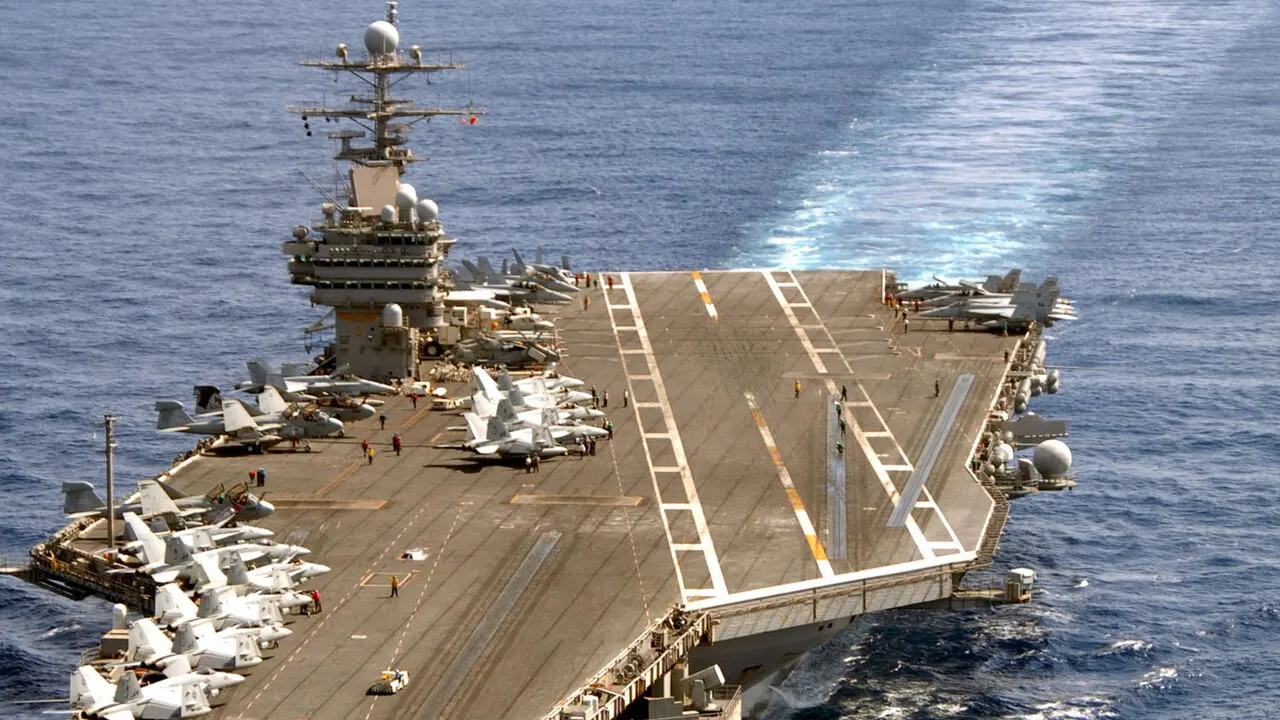
A third American aircraft carrier has arrived in the Middle East. A US official told Al Jazeera on Monday that the USS Theodore Roosevelt is now operating in the region, joining the USS George Washington and the USS George H.W. Bush. The United States now has three carrier strike groups in the area at once.
The Roosevelt left its home port of San Diego in September, according to a US official who spoke to Al Jazeera last month. A second official said the ship reached the Middle East on November 15. The Pentagon and US Central Command, which oversees American military operations in the region, have not formally confirmed the arrival.
The ship is a nuclear-powered carrier commissioned in 1986. It carries more than 5,000 personnel and an air wing of more than 60 aircraft, including F-18 fighter jets.
The carrier did not travel alone. The Makin Island Amphibious Ready Group, carrying more than 2,000 Marines, also sailed for the Middle East behind it, a US official told Al Jazeera last month. The Wall Street Journal reported the naval deployments could add 9,000 to 10,000 US troops in total, including sailors and Marines. The US military has not confirmed those figures either.
Why it matters
The arrival caps a months-long military buildup. Open-source analysts and flight-tracking data cited by Al Jazeera show the US has sent more than 120 aircraft to the region since early February — the largest surge of American air power in the Middle East since the Iraq War. The aircraft include F-35 and F-22 stealth jets, F-15s, F-16s, and E-3 Sentry radar planes.
About 40,000 to 50,000 US troops were already stationed in and around the Middle East as of mid-2025, spread across eight permanent bases in Bahrain, Egypt, Iraq, Jordan, Kuwait, Qatar, Saudi Arabia, and the United Arab Emirates. Since the fighting with Iran began, nearly 7,000 more have deployed, including two Marine groups built around the assault ships USS Tripoli and USS Boxer, plus about 2,000 soldiers from the 82nd Airborne Division's rapid-response force.
The arrival follows [Iran's strike on a US base in Bahrain](/article/iran-strikes-us-base-bahrain-riffa), and it lands as diplomacy to end the standoff has stalled. The US and Iran agreed to a two-week ceasefire in April and announced a broader understanding in June. That deal collapsed in early July, and mediators from Pakistan and Qatar have been working since then to stop the fighting from resuming.
What it means for the US
For the United States, the carrier is both a warning and a safety net. Three carrier groups give Washington the ability to strike quickly if talks collapse — and give Iran reason to think twice before hitting American bases in the Gulf. US troops stationed across the region are the ones most exposed if the standoff turns violent again.
The deployment also carries a political cost at home. President Donald Trump said last week that further strikes on Iran were "quite unlikely" and that the military part of the conflict was "effectively over." Sending a third carrier while saying the war is over sends a mixed message — and the Trump administration has looked divided on Iran since Republicans took heavy losses in this month's midterm elections.
There is a pocketbook angle too. Iran's foreign minister warned on Monday that US attacks threaten energy security across the Middle East, and the Strait of Hormuz — the narrow waterway much of the world's oil passes through — sits at the center of the standoff. A return to fighting in the Gulf would rattle oil markets and could push up fuel prices for Americans.
What happens next
Diplomacy has not died, but it is barely moving. Iran's parliamentary speaker and chief negotiator, Mohammad Bagher Ghalibaf, said last week that Tehran sent seven conditions for a deal through a Qatari mediator and is waiting for a US answer. Iran wants the US naval blockade lifted, sanctions eased, frozen funds released, fighting ended on all fronts, and a formal declaration that the war is over.
The timing is notable: [Trump is in Asia this week for a summit with China's Xi Jinping and Russia's Vladimir Putin](/article/trump-heads-to-asia-for-xi-putin-summit-amid-nvidia-fallout), leaving the Iran file largely to Vice President JD Vance, his lead negotiator. Trump told Vance, "We don't need a deal with Iran," and wrote on Truth Social that the US has Iran's money and its strait. Secretary of State Marco Rubio has argued the economic pressure campaign is working and that large-scale military action is likely unnecessary.
Analysts warn the danger is miscalculation. Ali Vaez of the International Crisis Group told Al Jazeera both sides are locked in a "perilous game of chicken," convinced striking first may be safer than waiting. "Diplomacy still has a pulse, but it is suffocating under the weight of mutual mistrust and maximalist demands," he said.