What happened
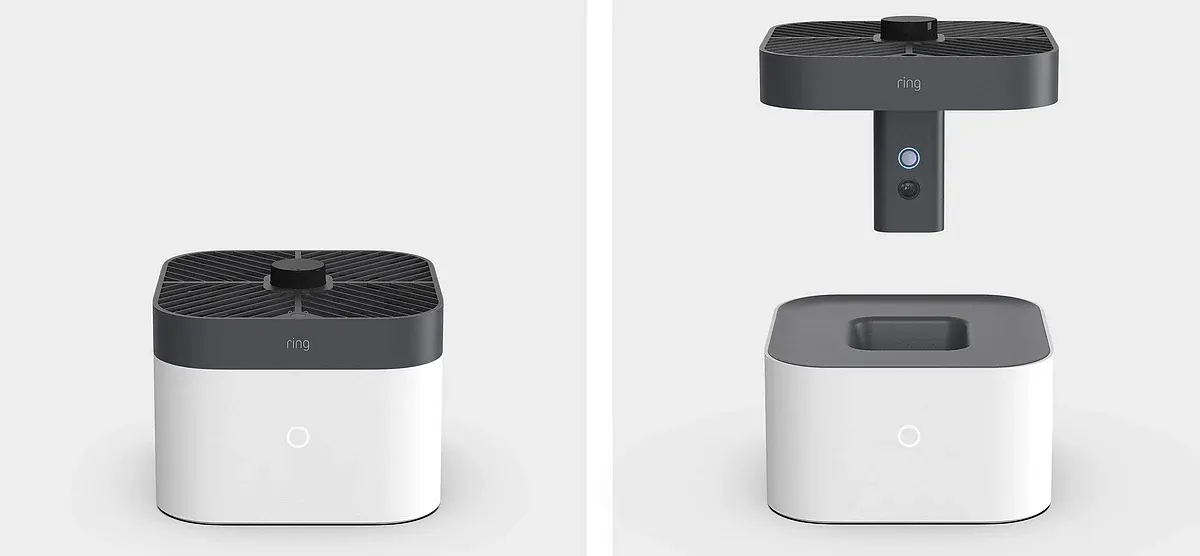
Amazon announced two roaming security devices on November 10: a flying Ring Drone Cam for homes and a wheeled Ring Rover Cam built for businesses. Both patrol on their own, guided by an AI system Amazon calls AI Pilot.
The Drone Cam costs $250 and is set to arrive January 27, 2027, if the Federal Communications Commission clears it for sale. It is the successor to Amazon's Ring Always Home Cam, an invite-only flying camera from September 2021 that carried the same $250 price.
The Rover Cam costs $1,000 and is already open for preorder, with shipping set to start December 16, 2026. Amazon describes it as "an autonomous security robot designed for business," shaped by feedback from its earlier Astro home robot. The launch keeps widening Amazon's AI hardware lineup, which already includes [Bee AI wearables](/article/amazon-bee-launches-two-ai-wearables-from-75).
Both devices map the space they patrol. AI Pilot uses cameras, specialized vision models, on-device sensors, and cloud processing to plan routes and steer around furniture. After a guided tour or a self-guided look around, the system can name rooms and suggest patrol points near side doors, windows, or a cash register in a shop.
The drone films in 2K with a 148-degree field of view and a camera that rotates 360 degrees. It flies for eight minutes on a new, fully charged battery under controlled conditions, then returns to its docking station. Owners with a Ring Protect plan can set its route and schedule, and it can launch on its own when a Ring camera, sensor, or alarm goes off. It is controlled from the Alexa Home Map, which shows a customer's Amazon-linked devices.
The Rover records and livestreams in up to 4K and can do a 360-degree scan from a fixed spot. Video from doorbell rings, motion events, and Live View is stored in the cloud for up to 180 days. It covers up to 5,000 square feet on a single floor, it cannot climb stairs, and an adjustable mast lets it see over counters and shelves. A siren, light tower, and two-way microphone let it announce itself and let an owner speak to someone nearby.
Why it matters
Fixed cameras only see what is in front of them. A camera that moves can check a back door, a stockroom, or a window that no fixed camera covers. For small businesses, the Rover is pitched as a cheaper stand-in for overnight patrols. For homeowners, the drone is a way to look in on the house from anywhere.
The catch is what a moving camera sees. A fixed doorbell camera films the porch. A drone or robot maps the floor plan and roams through bedrooms, offices, and storage areas. Ryan Calo, a law and technology researcher at the University of Washington, has warned that a flying camera inside a home gives companies access to sensitive details about the people and spaces inside it.
Ring's record makes that warning land harder. In 2023, the Federal Trade Commission charged that Ring let employees and contractors watch video from customers' private spaces, and that weak safeguards let hackers into 55,000 US customer accounts. Amazon says the new devices carry LED indicators and on-screen notices when recording is active, and that video is protected by Ring's Throw Away the Key Encryption, introduced in September 2026. The Electronic Frontier Foundation calls that encryption an improvement over Ring's old defaults, but still short of end-to-end encryption. The EFF has also criticized Ring founder Jamie Siminoff's "surveillance-first-privacy-last" approach, including Ring restoring features that let police request footage or live access. Consumer-tech privacy is under fresh scrutiny across the industry, including [Google's recent privacy change around Gmail data and ads](/article/google-privacy-change-gmail-data-ads).
Amazon says neither new device uses facial recognition. Its fixed doorbell cameras are another matter: Ring has let owners switch on a "Familiar Faces" facial-recognition feature since December 2025, and that feature is already the subject of a class-action lawsuit.
What happens next
The drone still needs FCC authorization before Amazon can sell it. The January 27 date holds only if that clearance comes through. Customers can sign up for email updates on the product page in the meantime.
The Rover ships first, on December 16, and its limits will get tested fast: no stairs, no floor transitions over 1.375 inches, no black glossy floors, and spotty navigation around mirrors, polished marble, and blank walls. Early buyers will also test whether eight minutes of flight is enough for the drone to do a useful patrol.
Regulators and privacy groups will be watching too. The FTC case is three years old, but Ring's encryption and police-request policies are current questions, and the Familiar Faces lawsuit is still open.